Detecting Traffic Engineering from public BGP data
This 2025 international conference paper, by Omar Darwich and 2 coauthors, was presented at Proceedings of the Passive and Active Measurement Conference (PAM). Topics covered include traffic engineering, internet measurements, and bgp instability.
Full author list: Omar Darwich, Cristel Pelsser, and Kevin Vermeulen.
Abstract
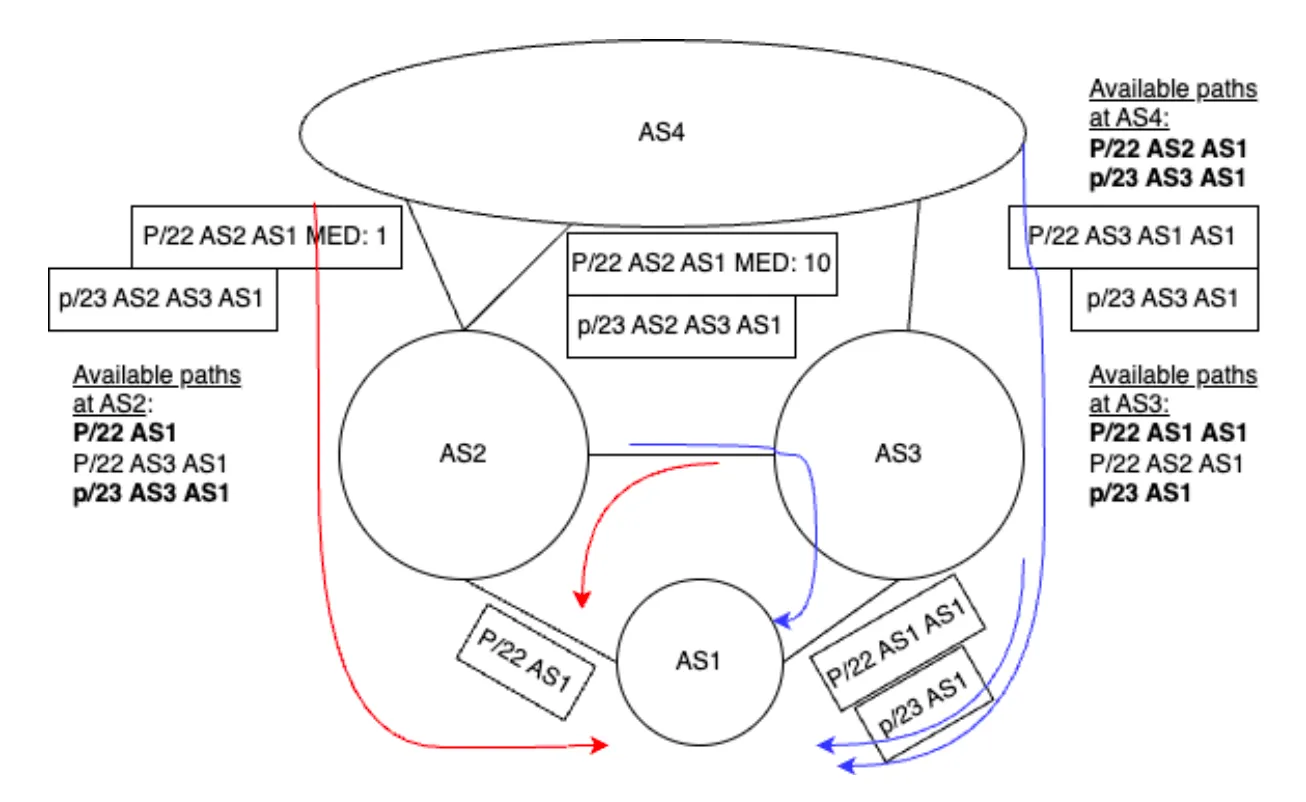
Routing is essential to the Internet functioning. However, more and more functions are added to BGP, the inter-AS routing protocol. In addition to providing connectivity for best effort service, it carries flow specification rules and blackholing signals to react to DDoS, routes for virtual private networks, IGP link-state database information among other uses. One such addition is the tweaking of BGP advertisements to engineer the traffic, to direct it on some preferred paths. In this paper we aim to estimate the impact of Traffic Engineering (TE) on the BGP ecosystem. We develop a method to detect the impact in space, that is, to find which traffic engineering technique impacts which prefix and which AS. We design a methodology to pinpoint TE events to quantify the impact on time. We find that on average, a BGP vantage point sees 35% of the announced prefixes impacted by TE. Quantifying the impact of TE on BGP stability, we find that TE events contribute to 39% of BGP updates and 44% of the BGP convergence time, and that prefixes belonging to hypergiants contribute the most to TE.
Publication Details
- Publication Type
- Conference Paper
- Publication Date
- March 2025
- Published In
- Proceedings of the Passive and Active Measurement Conference (PAM)
- Location
- Buenos Aires, Argentina
- External Link
- https://hal.science/hal-04840370
Suggested citation
Omar Darwich, Cristel Pelsser, and Kevin Vermeulen. 2025. Detecting Traffic Engineering from public BGP data. In Proceedings of the Passive and Active Measurement Conference (PAM). Buenos Aires, Argentina.
BibTeX Citation
BibTeX Citation
@inproceedings{Darwich2025,
	title        = {Detecting Traffic Engineering from public BGP data},
	author       = {Darwich, Omar and Pelsser, Cristel and Vermeulen, Kevin},
	year         = 2025,
	month        = mar,
	booktitle    = {Proceedings of the Passive and Active Measurement Conference ({PAM})},
	address      = {Buenos Aires, Argentina},
	url          = {https://hal.science/hal-04840370},
	organization = {Universidad de San Andrés},
	abstract     = {Routing is essential to the Internet functioning. However, more and more functions are added to BGP, the inter-AS routing protocol. In addition to providing connectivity for best effort service, it carries flow specification rules and blackholing signals to react to DDoS, routes for virtual private networks, IGP link-state database information among other uses. One such addition is the tweaking of BGP advertisements to engineer the traffic, to direct it on some preferred paths. In this paper we aim to estimate the impact of Traffic Engineering (TE) on the BGP ecosystem. We develop a method to detect the impact in space, that is, to find which traffic engineering technique impacts which prefix and which AS. We design a methodology to pinpoint TE events to quantify the impact on time. We find that on average, a BGP vantage point sees 35% of the announced prefixes impacted by TE. Quantifying the impact of TE on BGP stability, we find that TE events contribute to 39% of BGP updates and 44% of the BGP convergence time, and that prefixes belonging to hypergiants contribute the most to TE.},
	groups       = {International Conferences},
	hal_id       = {hal-04840370},
	hal_version  = {v1},
	keywords     = {Traffic Engineering, Internet Measurements, BGP Instability},
	pdf          = {https://hal.science/hal-04840370v1/file/te-paper.pdf}
}
Related publications
Où un opérateur IP cache-t-il ses détours?
Del Fiore, Julián Martín, Pascal Mérindol, and Cristel Pelsser
CoRes, 2021
The Art of Detecting Forwarding Detours
Julián Martín Del Fiore, Valerio Persico, and Pascal Mérindol, et al.
IEEE Transactions on Network and Service Management TNSM, 2021
Exploiting Vulnerabilities at IXP Route Servers to Perform Stealth BGP Hijacks
Gabby Rimlinger, Joaquim Pereira, and Matthieu Gouel, et al.
ACM CCS 2026, 2026
RPKI Time-of-Flight: Tracking Delays in the Management, Control, and Data Planes
Romain Fontugne, Amreesh Phokeer, and Cristel Pelsser, et al.
Passive and Active Measurement PAM, 2023