An analysis of the economic impact of strategic deaggregation
Andra Lutu , Marcelo Bagnulo , Cristel Pelsser , Kenjiro Cho and Rade Stanojevic
This 2015 international journal article, by Andra Lutu and 4 coauthors, was published in Computer Networks. Topics covered include bgp, traffic engineering, economics, modeling, and measurements.
Full author list: Andra Lutu, Marcelo Bagnulo, Cristel Pelsser, Kenjiro Cho, and Rade Stanojevic.
Abstract
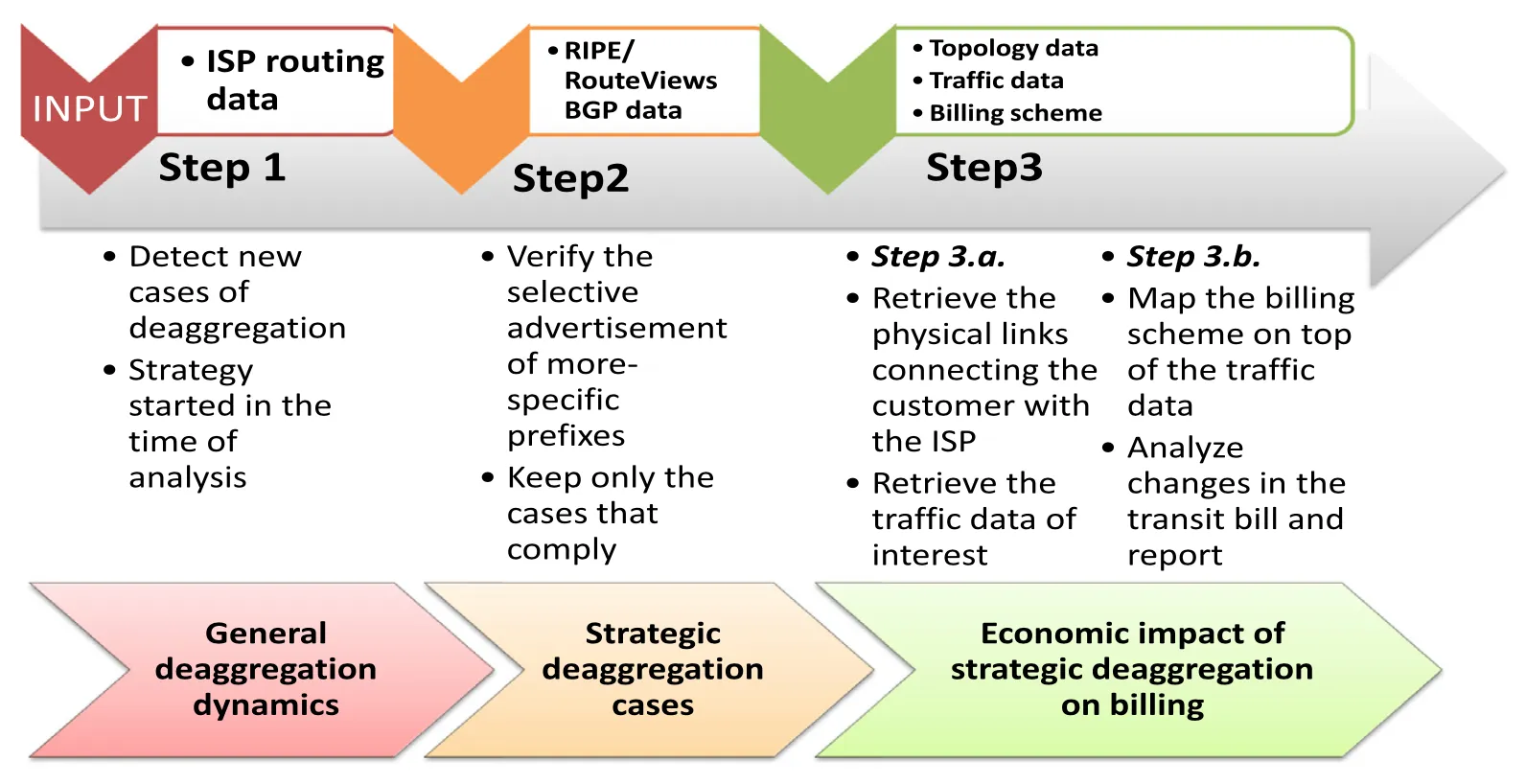
The advertisement of more-specific prefixes provides network operators with a fine-grained method to control the interdomain ingress traffic. Prefix deaggregation is recognized as a steady long-lived phenomenon at the interdomain level, despite its well-known negative effects for the community. In this paper, we look past the original motivation for deploying deaggregation in the first place, and instead we focus on its aftermath. We identify and analyze here one particular side-effect of deaggregation regarding the economic impact of this type of strategy: decreasing the transit traffic bill. We propose a general Internet model to analyze the effect of advertising more-specific prefixes on the incoming transit traffic burstiness. We show that deaggregation combined with selective advertisements has a traffic stabilization side-effect, which translates into a decrease of the transit traffic bill. Next, we develop a methodology for Internet Service Providers (ISPs) to monitor general occurrences of prefix deaggregation within their customer base. Thus, the ISPs can detect selective advertisements of deaggregated prefixes, and thus identify customers which impact the business of their providers. We apply the proposed methodology on a complete set of data including routing, traffic, topological and billing information provided by a major Japanese ISP and we discuss the obtained results.
Publication Details
- Publication Type
- Journal Article
- Publication Date
- March 2015
- Published In
- Computer Networks
- Volume & Issue
- Vol. 81
- Pages
- 147–163
- Digital Object Identifier (DOI)
- 10.1016/j.comnet.2015.02.008
Suggested citation
Andra Lutu, Marcelo Bagnulo, Cristel Pelsser, Kenjiro Cho, and Rade Stanojevic. 2015. An analysis of the economic impact of strategic deaggregation. Computer Networks 81 (Mar. 2015), 147–163. https://doi.org/10.1016/j.comnet.2015.02.008
BibTeX Citation
BibTeX Citation
@article{Lutu2015,
	title        = {An analysis of the economic impact of strategic deaggregation},
	author       = {Andra Lutu and Marcelo Bagnulo and Cristel Pelsser and Kenjiro Cho and Rade Stanojevic},
	year         = 2015,
	month        = mar,
	journal      = {Computer Networks},
	volume       = 81,
	pages        = {147--163},
	doi          = {10.1016/j.comnet.2015.02.008},
	abstract     = {The advertisement of more-specific prefixes provides network operators with a fine-grained method to control the interdomain ingress traffic. Prefix deaggregation is recognized as a steady long-lived phenomenon at the interdomain level, despite its well-known negative effects for the community. In this paper, we look past the original motivation for deploying deaggregation in the first place, and instead we focus on its aftermath. We identify and analyze here one particular side-effect of deaggregation regarding the economic impact of this type of strategy: decreasing the transit traffic bill. We propose a general Internet model to analyze the effect of advertising more-specific prefixes on the incoming transit traffic burstiness. We show that deaggregation combined with selective advertisements has a traffic stabilization side-effect, which translates into a decrease of the transit traffic bill. Next, we develop a methodology for Internet Service Providers (ISPs) to monitor general occurrences of prefix deaggregation within their customer base. Thus, the ISPs can detect selective advertisements of deaggregated prefixes, and thus identify customers which impact the business of their providers. We apply the proposed methodology on a complete set of data including routing, traffic, topological and billing information provided by a major Japanese ISP and we discuss the obtained results.},
	bibsource    = {dblp computer science bibliography, https://dblp.org},
	biburl       = {https://dblp.org/rec/journals/cn/LutuBPCS15.bib},
	groups       = {International Journals and Magazines},
	keywords     = {BGP, Traffic engineering, Economics, Modeling, Measurements}
}
Related publications
The Aftermath of Prefix Deaggregation
Andra Lutu, Cristel Pelsser, and Marcelo Bagnulo, et al.
Proceedings of the 2013 25th International Teletraffic Congress (ITC), 2013
The BGP Visibility Toolkit: Detecting Anomalous Internet Routing Behavior
Andra Lutu, Marcelo Bagnulo, and Cristel Pelsser, et al.
IEEE/ACM Transactions on Networking, 2015
Understanding the Reachability of IPv6 Limited Visibility Prefixes
Andra Lutu, Marcelo Bagnulo, and Cristel Pelsser, et al.
Passive and Active Measurement - 15th International Conference, PAM 2014, 2014
Exploiting Vulnerabilities at IXP Route Servers to Perform Stealth BGP Hijacks
Gabby Rimlinger, Joaquim Pereira, and Matthieu Gouel, et al.
ACM CCS 2026, 2026