Route Flap Damping Made Usable
Cristel Pelsser , Olaf Maennel , Pradosh Mohapatra , Randy Bush and Keyur Patel
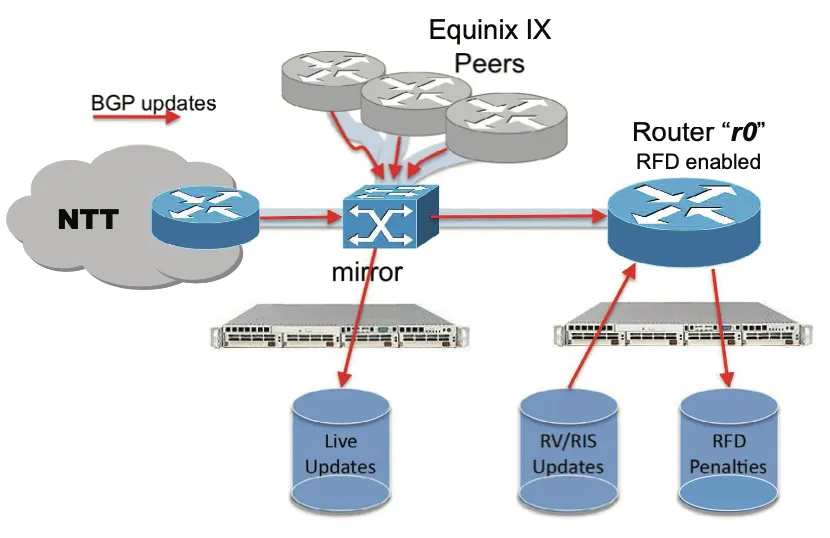
This 2011 international conference paper, by Cristel Pelsser and 4 coauthors, was presented at Passive and Active Measurement - 12th International Conference, PAM 2011. Topics covered include bgp, routing, and internet.
Full author list: Cristel Pelsser, Olaf Maennel, Pradosh Mohapatra, Randy Bush, and Keyur Patel.
Abstract
The Border Gateway Protocol (BGP), the de facto inter-domain routing protocol of the Internet, is known to be noisy. The protocol has two main mechanisms to ameliorate this, MinRouteAdvertisementInterval (MRAI), and Route Flap Damping (RFD). MRAI deals with very short bursts on the order of a few to 30 seconds. RFD deals with longer bursts, minutes to hours. Unfortunately, RFD was found to severely penalize sites for being well-connected because topological richness amplifies the number of update messages exchanged. So most operators have disabled it. Through measurement, this paper explores the avenue of absolutely minimal change to code, and shows that a few RFD algorithmic constants and limits can be trivially modified, with the result being damping a non-trivial amount of long term churn without penalizing well-behaved prefixes’ normal convergence process.
Publication Details
- Publication Type
- Conference Paper
- Publication Date
- March 2011
- Published In
- Passive and Active Measurement - 12th International Conference, PAM 2011
- Volume & Issue
- Vol. 6579
- Pages
- 143–152
- Publisher
- Springer
- Location
- Atlanta, GA, USA
- Digital Object Identifier (DOI)
- 10.1007/978-3-642-19260-9_15
Suggested citation
Cristel Pelsser, Olaf Maennel, Pradosh Mohapatra, Randy Bush, and Keyur Patel. 2011. Route Flap Damping Made Usable. In Passive and Active Measurement - 12th International Conference, PAM 2011. Springer, Atlanta, GA, USA, 143–152. https://doi.org/10.1007/978-3-642-19260-9_15
BibTeX Citation
BibTeX Citation
@inproceedings{Pelsser2011,
	title        = {Route Flap Damping Made Usable},
	author       = {Cristel Pelsser and Olaf Maennel and Pradosh Mohapatra and Randy Bush and Keyur Patel},
	year         = 2011,
	month        = mar,
	booktitle    = {Passive and Active Measurement - 12th International Conference, {PAM} 2011},
	location     = {Atlanta, GA, USA},
	publisher    = {Springer},
	series       = {Lecture Notes in Computer Science},
	volume       = 6579,
	pages        = {143--152},
	doi          = {10.1007/978-3-642-19260-9_15},
	editor       = {Neil Spring and George F. Riley},
	abstract     = {The Border Gateway Protocol (BGP), the de facto inter-domain routing protocol of the Internet, is known to be noisy. The protocol has two main mechanisms to ameliorate this, MinRouteAdvertisementInterval (MRAI), and Route Flap Damping (RFD). MRAI deals with very short bursts on the order of a few to 30 seconds. RFD deals with longer bursts, minutes to hours. Unfortunately, RFD was found to severely penalize sites for being well-connected because topological richness amplifies the number of update messages exchanged. So most operators have disabled it. Through measurement, this paper explores the avenue of absolutely minimal change to code, and shows that a few RFD algorithmic constants and limits can be trivially modified, with the result being damping a non-trivial amount of long term churn without penalizing well-behaved prefixes’ normal convergence process.},
	bibsource    = {dblp computer science bibliography, https://dblp.org},
	biburl       = {https://dblp.org/rec/conf/pam/PelsserMMBP11.bib},
	groups       = {International Conferences},
	keywords     = {BGP, Routing, Internet}
}
Related publications
The BGP Visibility Toolkit: Detecting Anomalous Internet Routing Behavior
Andra Lutu, Marcelo Bagnulo, and Cristel Pelsser, et al.
IEEE/ACM Transactions on Networking, 2015
Leveraging Inter-domain Stability for BGP Dynamics Analysis
Thomas Green, Anthony Lambert, and Cristel Pelsser, et al.
Passive and Active Measurement - 19th International Conference, PAM 2018, 2018
Leveraging interdomain stability for squeezed and juicy BGP dynamics
Thomas Green, Anthony Lambert, and Dario Rossi, et al.
7th PhD school on Traffic Monitoring and Analysis (TMA), 2017
Revisiting Recommended BGP Route Flap Damping Configurations
Clemens Mosig, Randy Bush, and Cristel Pelsser, et al.
Proc. of Network Traffic Measurement and Analysis Conference (TMA), 2021