BGP table fragmentation: what and who?
Julien Gamba , Romain Fontugne , Cristel Pelsser , Randy Bush and Emile Aben
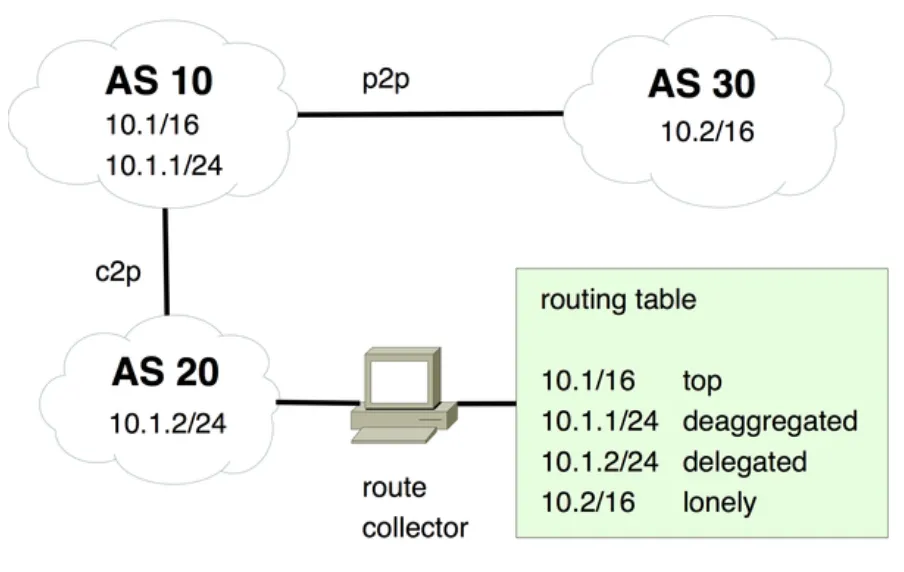
This 2017 national conference paper, by Julien Gamba and 4 coauthors, was presented at CoRes. Topics covered include bgp, internet routing table, prefix deaggregation, path prepending, and traffic engineering.
Full author list: Julien Gamba, Romain Fontugne, Cristel Pelsser, Randy Bush, and Emile Aben.
Abstract
BGP routing table growth is one of the major Internet scaling issues, and prefix deaggregation is thought to be a major contributor to table growth. In this work we quantify the fragmentation of the routing table by the type of IP prefix. We observe that the proportion of deaggregated prefixes has quasi doubled in the last fifteen years. Our study also shows that the deaggregated prefixes are the least stable; they appear and disappear more frequently. While we can not see significant differences in path prepending between the categories, deaggregated prefixes do tend to be announced more selectively, indicating traffic engineering. We find cases where lonely prefixes are actually deaggregation in disguise. Indeed, some large transit ISPs advertise many lonely prefixes when they own the covering prefix. We show the extents of this practice that has a negative impact on the routing table even though it could usually be avoided.
Publication Details
- Publication Type
- Conference Paper
- Publication Date
- May 2017
- Published In
- CoRes
- Location
- Quiberon, France
- External Link
- http://icube-publis.unistra.fr/5-GFPB17
Suggested citation
Julien Gamba, Romain Fontugne, Cristel Pelsser, Randy Bush, and Emile Aben. 2017. BGP table fragmentation: what and who?. In CoRes. Quiberon, France.
BibTeX Citation
BibTeX Citation
@inproceedings{Gamba2017,
	title        = {BGP table fragmentation: what and who?},
	author       = {Gamba, Julien and Fontugne, Romain and Pelsser, Cristel and Bush, Randy and Aben, Emile},
	year         = 2017,
	month        = may,
	booktitle    = {CoRes},
	address      = {Quiberon, France},
	url          = {http://icube-publis.unistra.fr/5-GFPB17},
	abstract     = {BGP routing table growth is one of the major Internet scaling issues, and prefix deaggregation is thought to be a major contributor to table growth. In this work we quantify the fragmentation of the routing table by the type of IP prefix. We observe that the proportion of deaggregated prefixes has quasi doubled in the last fifteen years. Our study also shows that the deaggregated prefixes are the least stable; they appear and disappear more frequently. While we can not see significant differences in path prepending between the categories, deaggregated prefixes do tend to be announced more selectively, indicating traffic engineering. We find cases where lonely prefixes are actually deaggregation in disguise. Indeed, some large transit ISPs advertise many lonely prefixes when they own the covering prefix. We show the extents of this practice that has a negative impact on the routing table even though it could usually be avoided.},
	groups       = {National Conferences},
	keywords     = {BGP, Internet routing table, prefix deaggregation, path prepending, traffic engineering},
	venue        = {CoRes},
	x-international-audience = {No},
	x-language   = {EN}
}
Related publications
Revisiting Recommended BGP Route Flap Damping Configurations
Clemens Mosig, Randy Bush, and Cristel Pelsser, et al.
Proc. of Network Traffic Measurement and Analysis Conference (TMA), 2021
Comparing Machine Learning Algorithms for BGP Anomaly Detection Using Graph Features
Odnan Ref Sanchez, Simone Ferlin, and Cristel Pelsser, et al.
Big-DAMA, 2019
Revisiting Route Flap Damping in the Wild
Clemens Mosig, Randy Bush, and Cristel Pelsser, et al.
Internet Measurement Conference (IMC), 2019
BGP Communities: Even more Worms in the Routing Can
Florian Streibelt, Franziska Lichtblau, and Robert Beverly, et al.
Proceedings of the Internet Measurement Conference 2018, IMC 2018, 2018