Talks & Presentations

Invited talks, keynotes, and presentations on Internet routing, network security, and traffic engineering.

5
Total Talks
2
Keynotes
5
Venues
2021–2026
Years Active

Showing 5 of 5 talks

2026
1 talk

Expanding BGP Data Horizons

Conference Talk January 27, 2026 PEPR Cybersécurité - École d'hiver 2026
Read abstract →
Expanding BGP Data Horizons at PEPR Cybersécurité - École d'hiver 2026
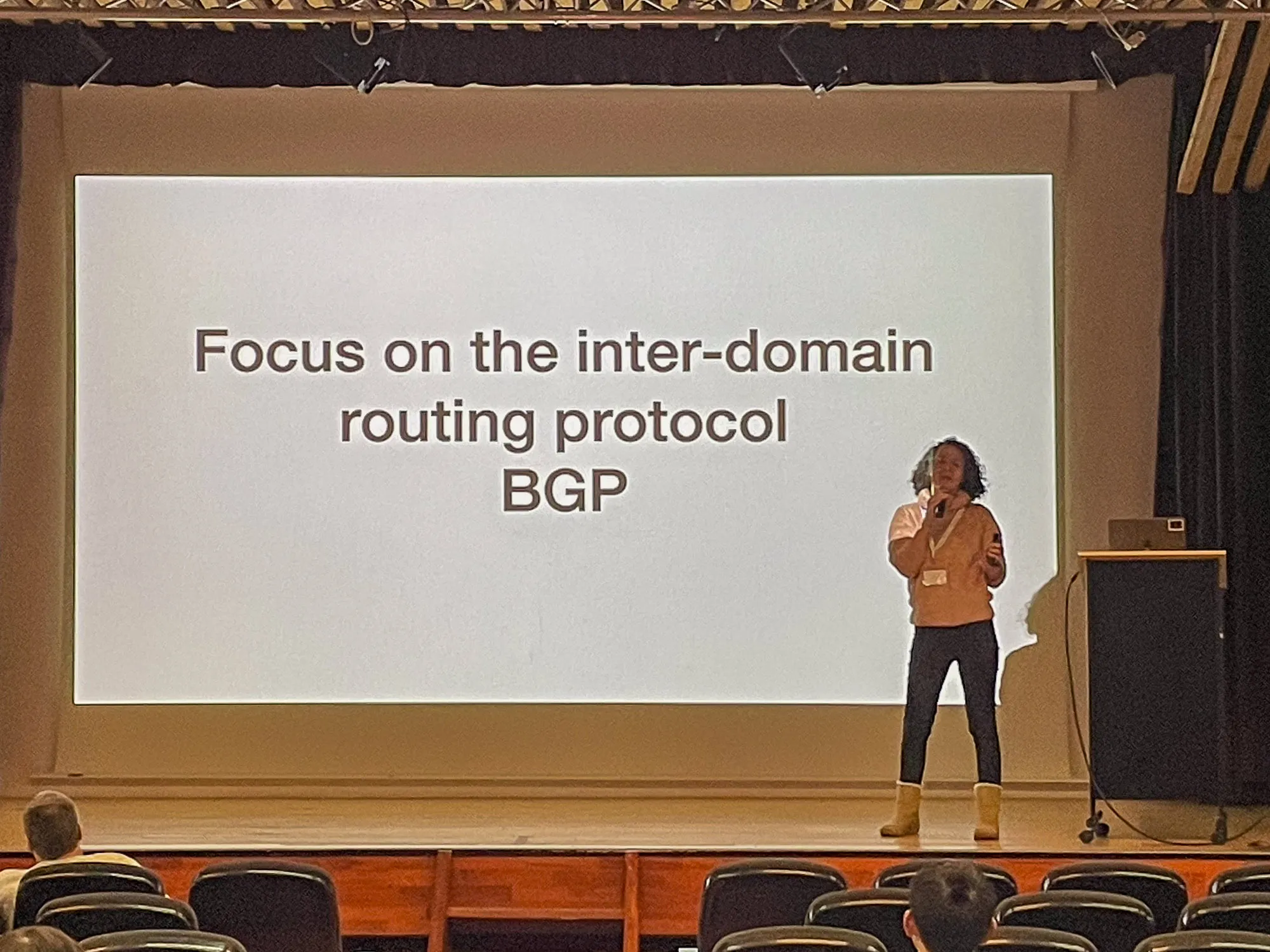
This talk addresses challenges in BGP data collection, focusing on redundancy and visibility gaps in current platforms. The talk introduces GILL, a new collection platform that enables data gathering from significantly more routers while controlling human effort and data volume through an overshoot-and-discard collection scheme allowing any AS to peer with GILL and export routes. Key topics include data compression algorithms for storing nonredundant routes, the bgproutes.io platform leveraging attribute redundancy, applications in topology mapping and AS ranking, and DFOH (a detector for forged-origin hijacks) that identifies BGP manipulation across the internet without relying on cryptographic extensions like BGPSec or ASPA.
2025
1 talk

Expanding BGP Data Horizons

Keynote June 12, 2025 TMA 2025 Keynote
Read abstract →
This keynote addresses challenges in BGP data collection, focusing on redundancy and visibility gaps in current platforms. The talk introduces GILL, a new collection platform that enables data gathering from significantly more routers while controlling human effort and data volume through an overshoot-and-discard collection scheme allowing any AS to peer with GILL and export routes. Key topics include data compression algorithms for storing nonredundant routes, the bgproutes.io platform leveraging attribute redundancy, applications in topology mapping and AS ranking, and DFOH (a detector for forged-origin hijacks) that identifies BGP manipulation across the internet without relying on cryptographic extensions like BGPSec or ASPA.
2023
1 talk

Protection against and detection of some routing vulnerabilities

Tutorial June 25, 2023 TMA PhD School 2023
Read abstract →
BGP, the routing protocol that runs between large networks was not designed with security in mind. In this class, I'll present some of the attacks that are possible ranging from hijacks, blackholing using communities, path manipulation, and BGP session resets. I'll then move on to present some of the proposal aimed at detecting attacks on the protocol. The difficulty in detecting issues in inter-domain routing lies in that BGP hides information on the details of the Internet topology. This property is a given as it is at the root of the scalability of the protocol. How do we aim to fill the holes to improve detection and better understand the Internet? This can be addressed by careful selection of the data to analyse and tailored detections techniques, that we present in this talk.
2022
1 talk

Multi-constrained paths with segment routing and the detection of forwarding detours

Webinar November 25, 2022 NGN Webinar
Read abstract →
With the growth of demands for quasi-instantaneous communication services such as real-time video streaming, cloud gaming, and industry 4.0 applications, multi-constraint Traffic Engineering (TE) becomes increasingly important. While legacy TE management planes have proven laborious to deploy, Segment Routing (SR) drastically eases the deployment of TE paths and thus became the most appropriate technology for many operators. The flexibility of SR sparked demands in ways to compute more elaborate paths. In particular, there exists a clear need in computing and deploying Delay-Constrained Least-Cost paths (DCLC) for real-time applications requiring both low delay and high bandwidth routes. However, most current DCLC solutions are heuristics not specifically tailored for SR. In this work, we leverage both inherent limitations in the accuracy of delay measurements and an operational constraint added by SR. We include these characteristics in the design of BEST2COP, an exact but efficient ECMP-aware algorithm that natively solves DCLC in SR domains. Through an extensive performance evaluation, we first show that BEST2COP scales well even in large random networks. In real networks having up to thousands of destinations, our algorithm returns all DCLC solutions encoded as SR paths in way less than a second. Segment routing, route aggregation and other TE techniques may introduce forwarding detours in an autonomous system. In the second part of the talk, I'll provide leads on how to detect forwarding detours. We study how traffic flows inside ASes. In case of detours, the forwarding routes do not match the best available routes, according to the internal gateway protocol (IGP) in use. We reveal such forwarding detours in multiple ASes.
2021
1 talk

Hidden broken pieces in the Internet - BGP lies and forwarding detours

Keynote March 28, 2021 PAM 2021 Keynote
Read abstract →
The Internet is an interconnection of independent networks known as Autonomous Systems (ASes). Given that ASes are built on top of hardware and software operated by humans, the Internet is subject to some limitations. For example, humans are error-prone and eventually take arbitrary decisions, enterprises are generally greedy from a revenue point of view. Finally, hardware and circuits may fail, requiring maintenance or replacement. All these factors may lead the Internet to have broken pieces, i.e., malfunctioning components, networks facing limitations and even selfish networks prioritizing their own revenue rather than the better performance of the Internet. Much of my current work is on measuring the Internet to understand its vulnerabilities. In this talk, I'll focus on two hidden broken pieces of the Internet. First, I'll concentrate on the border gateway protocol (BGP), the routing protocol used on the Internet, and study whether ASes carry on BGP lies where the control plane and the data plane differs. After applying a sequence of filters to remove different artifacts, we find cases where the paths indeed mismatch. One cause for such discrepancy is the presence of detours. We then study how traffic flows inside ASes and focus on the detection of forwarding detours. In case of detours, the forwarding routes do not match the best available routes, according to the internal gateway protocol (IGP) in use. We reveal such forwarding detours in multiple ASes.