Pushing Quality of Service Across Inter-domain Boundaries
Bingjie Fu , Cristel Pelsser and Steve Uhlig
This 2008 book chapter, by Bingjie Fu and 2 coauthors, was published as a chapter in End‐to‐End Quality of Service Engineering in Next Generation Heterogenous Networks. Topics covered include inter-domain, information, computation techniques, autonomous, and implications.
Full author list: Bingjie Fu, Cristel Pelsser, and Steve Uhlig.
Abstract
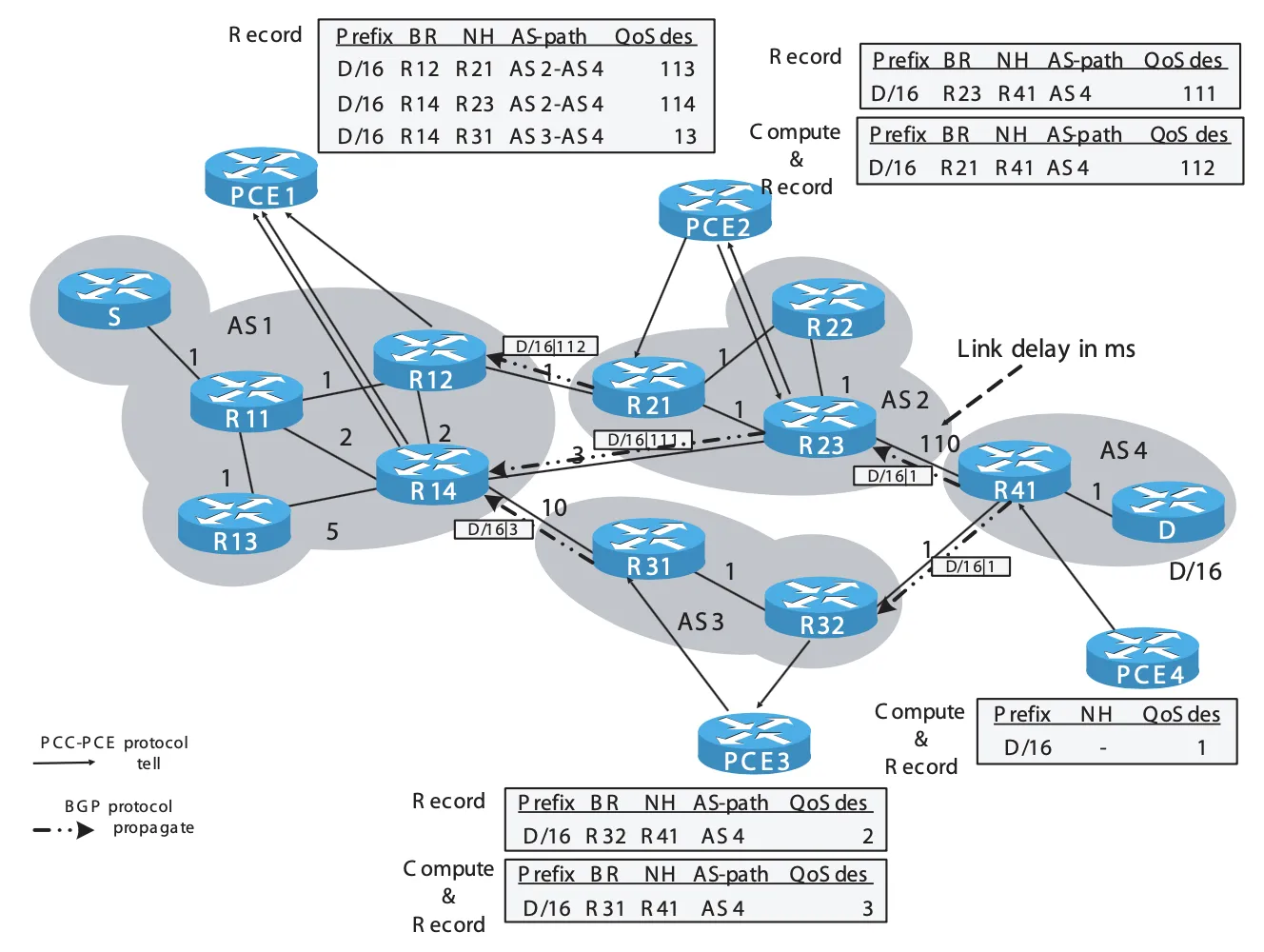
In this chapter, we introduce the current techniques and the remaining challenges for establishing inter-AS LSPs with QoS guarantees. We describe the workings of the inter-domain routing system. We discuss the consequences of path selection made by the current inter-domain routing system on the visibility of the paths. The limited visibility of path diversity does not actually prevent the establishment of inter-AS LSPs with QoS guarantees. Rather, the lack of QoS information requires clever heuristics to be designed in order to guide the search towards feasible QoS paths. We cover the existing signaling extensions to RSVP-TE that support the establishment of inter-AS LSPs, as well as the protection of those LSPs. The path computation techniques that have been proposed at the IETF are also detailed. Such computation techniques make it possible to find the LSP segments within each AS, in order to compose an end-to-end LSP with QoS guarantees when the sequence of ASs to be crossed is known. Finally, combine these three components, i.e. inter-domain routing, LSP signaling and path computation techniques. We show that inter-AS QoS is not beyond reach, but that more work needs to be done in specific areas, especially concerning heuristics to guide the search towards AS sequences across which feasible QoS paths can be found.
Publication Details
- Publication Type
- Book Chapter
- Publication Date
- November 2008
- Published In
- End‐to‐End Quality of Service Engineering in Next Generation Heterogenous Networks
- Pages
- 135–162
- Publisher
- John Wiley & Sons, Ltd
- Location
- London, UK
- Digital Object Identifier (DOI)
- https://doi.org/10.1002/9780470611470.ch6
- External Link
- http://www.iste.co.uk/book.php?id=242
Suggested citation
Bingjie Fu, Cristel Pelsser, and Steve Uhlig. 2008. Pushing Quality of Service Across Inter-domain Boundaries. In End‐to‐End Quality of Service Engineering in Next Generation Heterogenous Networks. John Wiley & Sons, Ltd, London, UK, 135–162. https://doi.org/https://doi.org/10.1002/9780470611470.ch6
BibTeX Citation
BibTeX Citation
@inbook{Fu2008,
	title        = {Pushing Quality of Service Across Inter-domain Boundaries},
	author       = {Bingjie Fu and Cristel Pelsser and Steve Uhlig},
	year         = 2008,
	month        = nov,
	booktitle    = {End‐to‐End Quality of Service Engineering in Next Generation Heterogenous Networks},
	publisher    = {John Wiley & Sons, Ltd},
	address      = {London, UK},
	pages        = {135--162},
	doi          = {https://doi.org/10.1002/9780470611470.ch6},
	isbn         = 9780470611470,
	url          = {http://www.iste.co.uk/book.php?id=242},
	chapter      = 6,
	abstract     = {In this chapter, we introduce the current techniques and the remaining challenges for establishing inter-AS LSPs with QoS guarantees. We describe the workings of the inter-domain routing system. We discuss the consequences of path selection made by the current inter-domain routing system on the visibility of the paths. The limited visibility of path diversity does not actually prevent the establishment of inter-AS LSPs with QoS guarantees. Rather, the lack of QoS information requires clever heuristics to be designed in order to guide the search towards feasible QoS paths. We cover the existing signaling extensions to RSVP-TE that support the establishment of inter-AS LSPs, as well as the protection of those LSPs. The path computation techniques that have been proposed at the IETF are also detailed. Such computation techniques make it possible to find the LSP segments within each AS, in order to compose an end-to-end LSP with QoS guarantees when the sequence of ASs to be crossed is known. Finally, combine these three components, i.e. inter-domain routing, LSP signaling and path computation techniques. We show that inter-AS QoS is not beyond reach, but that more work needs to be done in specific areas, especially concerning heuristics to guide the search towards AS sequences across which feasible QoS paths can be found.},
	eprint       = {https://onlinelibrary.wiley.com/doi/pdf/10.1002/9780470611470.ch6},
	groups       = {Book chapters},
	keywords     = {inter-domain, information, computation techniques, autonomous, implications}
}
Related publications
oBGP: An Overlay for a Scalable iBGP Control Plane
Iuniana Oprescu, Mickaël Meulle, and Steve Uhlig, et al.
10th IFIP Networking Conference (NETWORKING), 2011
Rethinking iBGP routing
Iuniana Oprescu, Mickael Meulle, and Steve Uhlig, et al.
Proceedings of the ACM SIGCOMM 2010 Conference on Applications, Technologies, Architectures, and Protocols for Computer Communications, 2010
Rethinking iBGP Routing
Iuniana Oprescu, Mickael Meulle, and Steve Uhlig, et al.
SIGCOMM 2010 Poster/Demo, 2010
Providing scalable NH-diverse iBGP route re-distribution to achieve sub-second switch-over time
Cristel Pelsser, Steve Uhlig, and Tomonori Takeda, et al.
Computer Networks, 2010