The BGP Visibility Toolkit: Detecting Anomalous Internet Routing Behavior
Andra Lutu , Marcelo Bagnulo , Cristel Pelsser , Olaf Maennel and Jesús Cid-Sueiro
This 2015 international journal article, by Andra Lutu and 4 coauthors, was published in IEEE/ACM Transactions on Networking. Topics covered include routing, internet, monitoring, feeds, machine learning algorithms, communities, writing, anomaly detection, bgp, internet measurement, and machine assembly.
Full author list: Andra Lutu, Marcelo Bagnulo, Cristel Pelsser, Olaf Maennel, and Jesús Cid-Sueiro.
Abstract
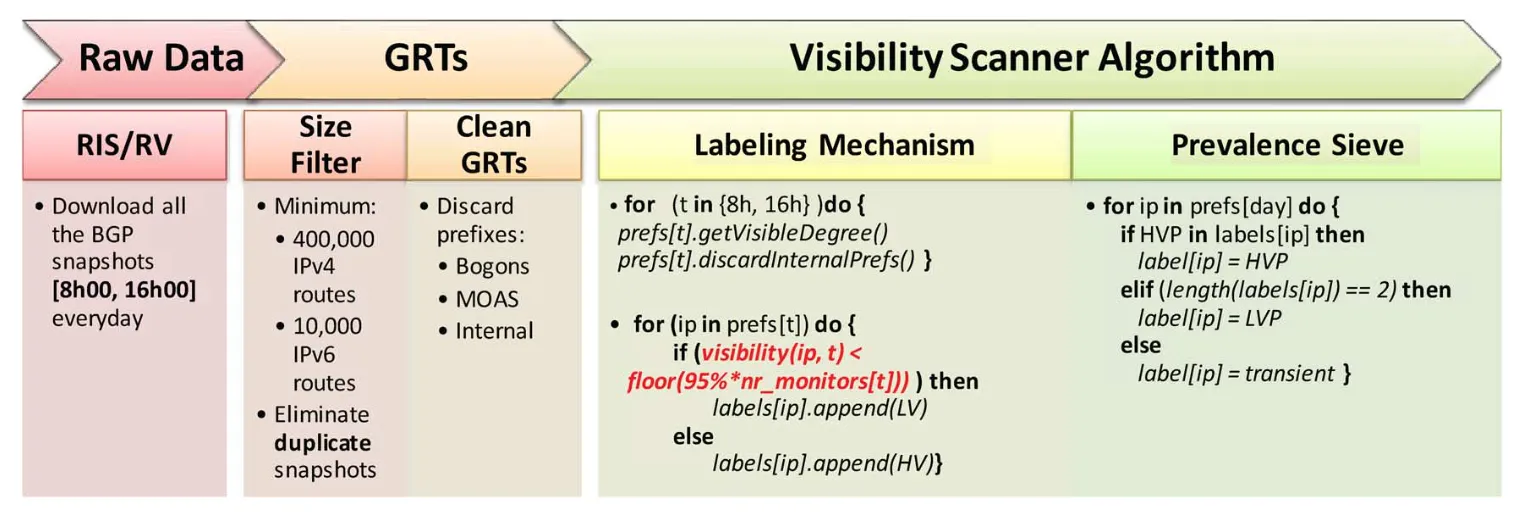
In this paper, we propose the BGP Visibility Toolkit, a system for detecting and analyzing anomalous behavior in the Internet. We show that interdomain prefix visibility can be used to single out cases of erroneous demeanors resulting from misconfiguration or bogus routing policies. The implementation of routing policies with BGP is a complicated process, involving fine-tuning operations and interactions with the policies of the other active ASes. Network operators might end up with faulty configurations or unintended routing policies that prevent the success of their strategies and impact their revenues. As part of the Visibility Toolkit, we propose the BGP Visibility Scanner, a tool which identifies limited visibility prefixes in the Internet. The tool enables operators to provide feedback on the expected visibility status of prefixes. We build a unique set of ground-truth prefixes qualified by their ASes as intended or unintended to have limited visibility. Using a machine learning algorithm, we train on this unique dataset an alarm system that separates with 95% accuracy the prefixes with unintended limited visibility. Hence, we find that visibility features are generally powerful to detect prefixes which are suffering from inadvertent effects of routing policies. Limited visibility could render a whole prefix globally unreachable. This points towards a serious problem, as limited reachability of a non-negligible set of prefixes undermines the global connectivity of the Internet. We thus verify the correlation between global visibility and global connectivity of prefixes.
Publication Details
- Publication Type
- Journal Article
- Publication Date
- April 2015
- Published In
- IEEE/ACM Transactions on Networking
- Volume & Issue
- Vol. 24, No. 2
- Pages
- 1237–1250
- Publisher
- IEEE
- Digital Object Identifier (DOI)
- 10.1109/TNET.2015.2413838
Suggested citation
Andra Lutu, Marcelo Bagnulo, Cristel Pelsser, Olaf Maennel, and Jesús Cid-Sueiro. 2015. The BGP Visibility Toolkit: Detecting Anomalous Internet Routing Behavior. IEEE/ACM Transactions on Networking 24, 2 (Apr. 2015), 1237–1250. https://doi.org/10.1109/TNET.2015.2413838
BibTeX Citation
BibTeX Citation
@article{Lutu2016,
	title        = {The BGP Visibility Toolkit: Detecting Anomalous Internet Routing Behavior},
	author       = {Andra Lutu and Marcelo Bagnulo and Cristel Pelsser and Olaf Maennel and Jes{\'{u}}s Cid{-}Sueiro},
	year         = 2015,
	month        = apr,
	journal      = {IEEE/ACM Transactions on Networking},
	publisher    = {IEEE},
	volume       = 24,
	number       = 2,
	pages        = {1237--1250},
	doi          = {10.1109/TNET.2015.2413838},
	issn         = {1558-2566},
	abstract     = {In this paper, we propose the BGP Visibility Toolkit, a system for detecting and analyzing anomalous behavior in the Internet. We show that interdomain prefix visibility can be used to single out cases of erroneous demeanors resulting from misconfiguration or bogus routing policies. The implementation of routing policies with BGP is a complicated process, involving fine-tuning operations and interactions with the policies of the other active ASes. Network operators might end up with faulty configurations or unintended routing policies that prevent the success of their strategies and impact their revenues. As part of the Visibility Toolkit, we propose the BGP Visibility Scanner, a tool which identifies limited visibility prefixes in the Internet. The tool enables operators to provide feedback on the expected visibility status of prefixes. We build a unique set of ground-truth prefixes qualified by their ASes as intended or unintended to have limited visibility. Using a machine learning algorithm, we train on this unique dataset an alarm system that separates with 95% accuracy the prefixes with unintended limited visibility. Hence, we find that visibility features are generally powerful to detect prefixes which are suffering from inadvertent effects of routing policies. Limited visibility could render a whole prefix globally unreachable. This points towards a serious problem, as limited reachability of a non-negligible set of prefixes undermines the global connectivity of the Internet. We thus verify the correlation between global visibility and global connectivity of prefixes.},
	bibsource    = {dblp computer science bibliography, https://dblp.org},
	biburl       = {https://dblp.org/rec/journals/ton/LutuBPMC16.bib},
	file         = {:https\://ieeexplore.ieee.org/stamp/stamp.jsp?tp=&arnumber=7091956:PDF},
	groups       = {International Journals and Magazines},
	issue        = 2,
	keywords     = {Routing, Internet, Monitoring, Feeds, Machine learning algorithms, Communities, Writing, Anomaly detection, BGP, Internet measurement, machine assembly},
	numpages     = 14
}
Related publications
The Aftermath of Prefix Deaggregation
Andra Lutu, Cristel Pelsser, and Marcelo Bagnulo, et al.
Proceedings of the 2013 25th International Teletraffic Congress (ITC), 2013
Route Flap Damping Made Usable
Cristel Pelsser, Olaf Maennel, and Pradosh Mohapatra, et al.
Passive and Active Measurement - 12th International Conference, PAM 2011, 2011
Leveraging Inter-domain Stability for BGP Dynamics Analysis
Thomas Green, Anthony Lambert, and Cristel Pelsser, et al.
Passive and Active Measurement - 19th International Conference, PAM 2018, 2018
Leveraging interdomain stability for squeezed and juicy BGP dynamics
Thomas Green, Anthony Lambert, and Dario Rossi, et al.
7th PhD school on Traffic Monitoring and Analysis (TMA), 2017