Improving Network Agility With Seamless BGP Reconfigurations
Stefano Vissicchio , Laurent Vanbever , Cristel Pelsser , Luca Cittadini , Pierre François and Olivier Bonaventure
This 2013 international journal article, by Stefano Vissicchio and 5 coauthors, was published in IEEE/ACM Transactions on Networking. Topics covered include routing, topology, best practices, network topology, oscillators, routing protocols, ieee transactions, bgp, configuration, migration, reconfiguration, ships in the night, and vrf.
Full author list: Stefano Vissicchio, Laurent Vanbever, Cristel Pelsser, Luca Cittadini, Pierre François, and Olivier Bonaventure.
Abstract
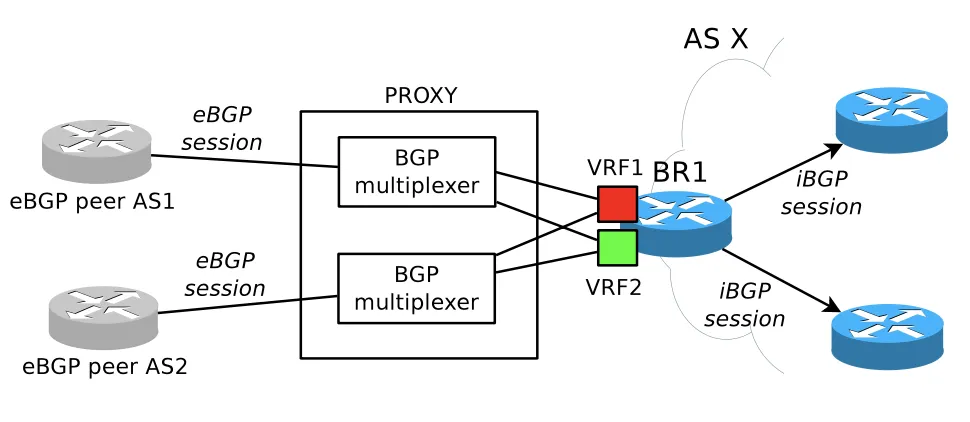
The network infrastructure of Internet service providers (ISPs) undergoes constant evolution. Whenever new requirements arise (e.g., the deployment of a new Point of Presence or a change in the business relationship with a neighboring ISP), operators need to change the configuration of the network. Due to the complexity of the Border Gateway Protocol (BGP) and the lack of methodologies and tools, maintaining service availability during reconfigurations that involve BGP is a challenge for operators. In this paper, we show that the current best practices to reconfigure BGP do not provide guarantees with respect to traffic disruptions. Then, we study the problem of finding an operational ordering of BGP reconfiguration steps that guarantees no packet loss. Unfortunately, finding such an operational ordering, when it exists, is computationally hard. To enable lossless reconfigurations, we propose a framework that extends current features of carrier-grade routers to run two BGP control planes in parallel. We present a prototype implementation and show the effectiveness of our framework through a case study.
Publication Details
- Publication Type
- Journal Article
- Publication Date
- June 2013
- Published In
- IEEE/ACM Transactions on Networking
- Volume & Issue
- Vol. 21, No. 3
- Pages
- 990–1002
- Publisher
- IEEE
- Digital Object Identifier (DOI)
- 10.1109/TNET.2012.2217506
Suggested citation
Stefano Vissicchio, Laurent Vanbever, Cristel Pelsser, Luca Cittadini, Pierre François, and Olivier Bonaventure. 2013. Improving Network Agility With Seamless BGP Reconfigurations. IEEE/ACM Transactions on Networking 21, 3 (Jun. 2013), 990–1002. https://doi.org/10.1109/TNET.2012.2217506
BibTeX Citation
BibTeX Citation
@article{Vissicchio2013,
	title        = {Improving Network Agility With Seamless BGP Reconfigurations},
	author       = {Stefano Vissicchio and Laurent Vanbever and Cristel Pelsser and Luca Cittadini and Pierre Fran{\c{c}}ois and Olivier Bonaventure},
	year         = 2013,
	month        = jun,
	journal      = {IEEE/ACM Transactions on Networking},
	publisher    = {IEEE},
	volume       = 21,
	number       = 3,
	pages        = {990--1002},
	doi          = {10.1109/TNET.2012.2217506},
	issn         = {1558-2566},
	abstract     = {The network infrastructure of Internet service providers (ISPs) undergoes constant evolution. Whenever new requirements arise (e.g., the deployment of a new Point of Presence or a change in the business relationship with a neighboring ISP), operators need to change the configuration of the network. Due to the complexity of the Border Gateway Protocol (BGP) and the lack of methodologies and tools, maintaining service availability during reconfigurations that involve BGP is a challenge for operators. In this paper, we show that the current best practices to reconfigure BGP do not provide guarantees with respect to traffic disruptions. Then, we study the problem of finding an operational ordering of BGP reconfiguration steps that guarantees no packet loss. Unfortunately, finding such an operational ordering, when it exists, is computationally hard. To enable lossless reconfigurations, we propose a framework that extends current features of carrier-grade routers to run two BGP control planes in parallel. We present a prototype implementation and show the effectiveness of our framework through a case study.},
	bibsource    = {dblp computer science bibliography, https://dblp.org},
	biburl       = {https://dblp.org/rec/journals/ton/VissicchioVPCFB13.bib},
	file         = {:Vissicchio2013 - Improving Network Agility with Seamless BGP Reconfigurations.pdf:PDF},
	groups       = {International Journals and Magazines},
	issue        = 3,
	keywords     = {Routing, Topology, Best practices, Network topology, Oscillators, Routing protocols, IEEE transactions, BGP, configuration, migration, reconfiguration, ships in the night, VRF},
	award        = {Applied Networking Research Prize (ANRP)}
}
Related publications
Lossless migrations of link-state IGPs
Laurent Vanbever, Stefano Vissicchio, and Cristel Pelsser, et al.
IEEE/ACM Transactions on Networking, 2012
Seamless Network-Wide IGP Migrations
Laurent Vanbever, Stefano Vissicchio, and Cristel Pelsser, et al.
Proceedings of the ACM SIGCOMM 2011 Conference on Applications, Technologies, Architectures, and Protocols for Computer Communications, 2011
Routing over QUIC: Bringing transport innovations to routing protocols
Thomas Wirtgen, Nicolas Rybowski, and Cristel Pelsser, et al.
Poster session of the 20th USENIX Symposium on Networked Systems Design and Implementation (NSDI 23' Poster Session), 2023
Interdomain traffic engineering with BGP
Bruno Quoitin, Cristel Pelsser, and Louis Swinnen, et al.
IEEE Communications Magazine, 2003